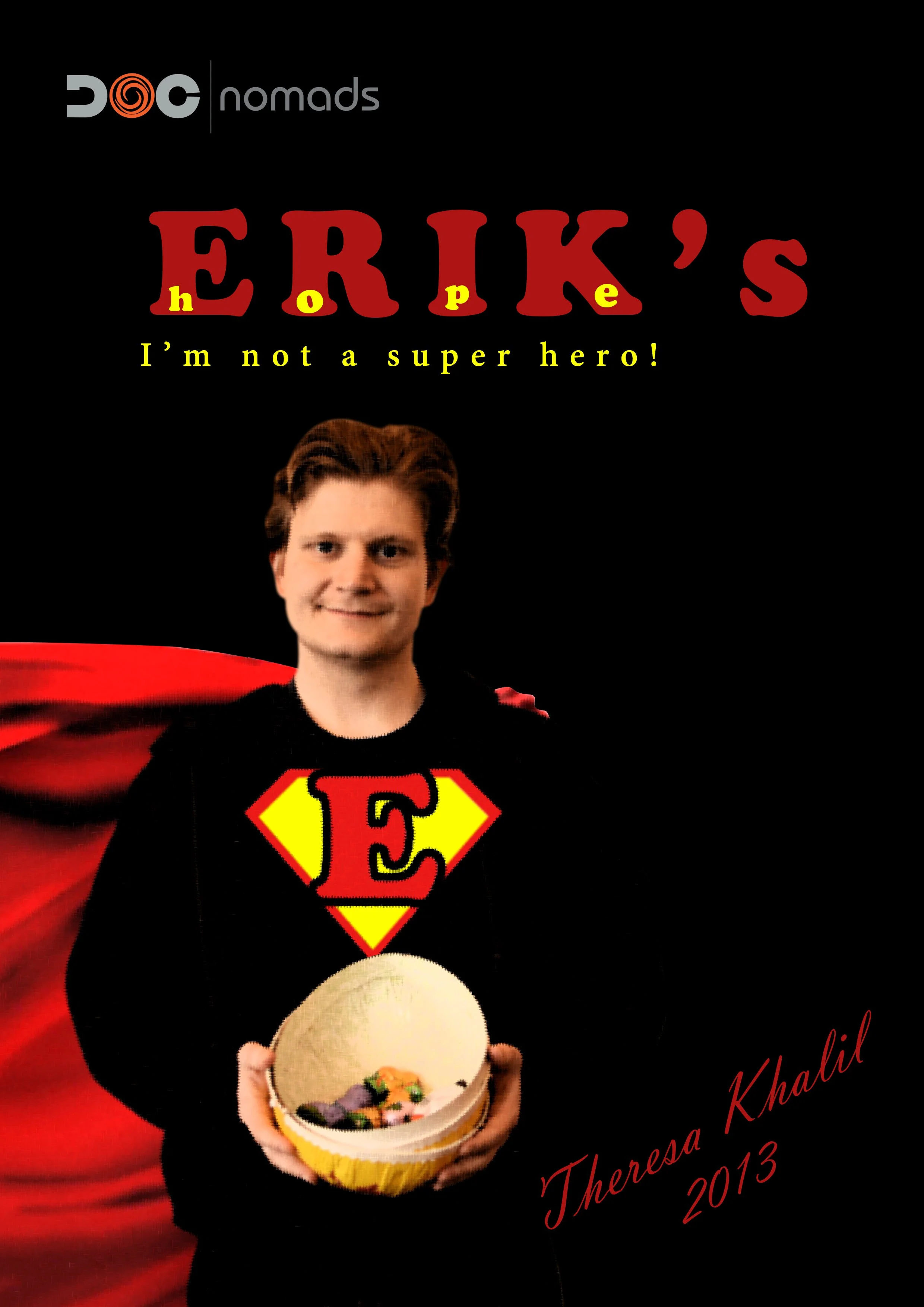
Erik’s Hope
Erik is an actor but he stutters.
Short documentary shot in Budapest- Hungary.
The film was Produced by "Docnomads" 2013 and screened at szfe university in Budapest.
Featuring Erik Hakansson
Directed By Theresa Khalil


Behind the Scenes of Filming Erik’s Hope
I want to take you behind the scenes of my short documentary Erik’s Hope, and share some of the challenges, unexpected moments, and decisions that shaped the film.
Starting with almost no budget
My budget for this film was almost $0.
The film was produced as part of the DocNomads Joint Master’s Degree, but we were not given a financial budget for making our films.
I had my DSLR camera, a Nikon D5100, and I was able to borrow a Zoom H4n recorder and a shotgun microphone from the university. Transportation and other expenses came out of my own pocket.
But having almost no budget didn't stop me from making the film.
Finding Erik
The only requirement we had was that the word “hope” had to appear in the title.
At the time, I was living in Budapest, Hungary, where I didn't speak the language. My social circle was mostly made up of my Master's colleagues and a few expats I had met through Couchsurfing.
I usually let my instinct guide me when I'm looking for a story.
If I see an event that catches my attention or hear about something I'm curious about, I go. I explore, meet people, and see where the story takes me.
That's how I found Erik.
I was attending a documentary film club that met every Sunday in an underground café. We would watch a documentary and discuss it afterward. Luckily, everything was in English.
That's where I met him.
Something about Erik immediately caught my attention—his way of talking, his body language, and his appearance.
After a short conversation, I asked him if I could make a documentary about him.
Then I discovered that he was an actor.
And I wondered:
Can someone who stutters be an actor?
When your protagonist says no
Erik said no.
He told me he could act in a feature film, but he didn't want to be the subject of a documentary because he valued his privacy.
At that point, I had a choice: forget the idea and find someone else, or take the time to get to know him.
I chose the second.
Building trust
Over the following days, I met Erik a few more times.
Slowly, we got to know each other, and he began to trust me. Eventually, he invited me to his home to meet his family.
His mother had also worked in the film industry, which gave us something to connect over.
When I asked him again if he would take part in my documentary, this time he said yes.
And that's when the real filming began.
The challenge of filming someone's vulnerability
One of the biggest challenges I faced was deciding what to show and what not to show.
Erik was very insecure about his stutter. He didn't want it to appear in the film.
But for me, his stutter was an important part of the story. The film was about how he faced this challenge and found a way to overcome it through acting.
This raised an important question for me as a filmmaker:
Is it my film, or is it the protagonist's film?
I didn't want to exploit his vulnerability, but I also didn't want to hide the very thing that made his story meaningful.
So I continued filming.
When the film was finished, Erik finally watched it.
And instead of objecting to the scenes where he stuttered, he understood what I was trying to say.
He told me:
“It is good to give people hope.”
And that sentence became, for me, the perfect ending to the story.
Looking back
Erik's Hope was one of my first documentaries, and making it taught me that documentary filmmaking isn't only about having the right equipment or a big budget.
Sometimes, it's about following your instinct, approaching a stranger, building trust, and being brave enough to tell a story as honestly as you can.
Now you can watch Erik's Hope.